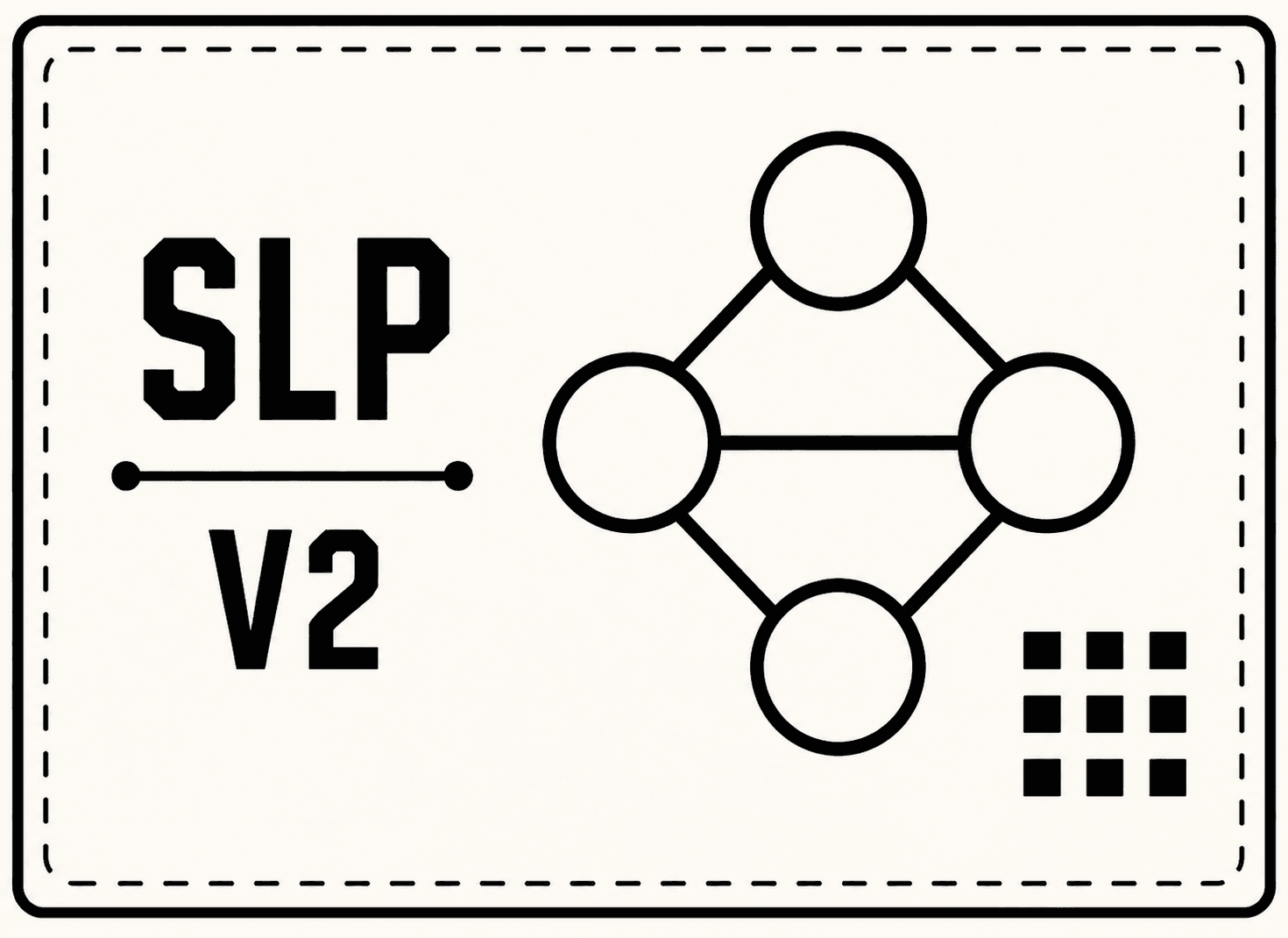
On August 31, 2026, I documented the design for SLP V2. Later that night, the V2 rewrite replaced V1 in Maestro.
V1 had accumulated Supervisors, Leads, Peers, Observers, Advisors, sensors, lanes, dispatches, handbacks, councils, and receipts. Each addition addressed a failure mode. Together, they made small jobs harder to start and harder to finish.
I built SLP inside Maestro to coordinate supervised teams of AI agents. Agents eventually had to learn a second job: operating SLP.
An agent could not return a result until it understood which object to create, which lifecycle it belonged to, who could close it, and which record would prove the work had happened. The coordination layer was consuming the attention it was meant to protect.
When Coordination Became Work
Multiple agents create problems that a single-agent workflow can avoid.
Two agents may edit the same file without knowing it. A result may sit unread because nobody owns acceptance. A decision may appear in chat but disappear from the durable project state. An agent may declare success while the reviewer is still waiting for evidence.
I added mechanisms as these cases appeared. Dispatches described assigned work. Handbacks carried results. Receipts recorded actions. Observers watched the team. Advisors added another layer of judgment. Lanes separated parallel approaches.
The vocabulary grew faster than the team's ability to use it.
A framework should make the next action obvious. SLP was making agents think about orchestration before they could think about the problem. Agents exchanged structured envelopes when a direct conversation would have worked better.
I cut the public workflow back.
Four Roles With Direct Channels
SLP V2 has four roles.
The Hub Supervisor manages teams across projects. It starts teams, reads cross-team status, and handles owner-level decisions.
The Team Supervisor owns one team inside one workspace. It coordinates that team, reviews the Lead's result, and remains the Hub's connection to the team.
The Lead breaks down the technical problem, assigns bounded work to Peers, integrates their results, and reviews what they return.
A Peer executes a specific assignment while keeping enough independence to question assumptions, challenge the Lead, or compare notes with another Peer.
The Human remains the owner above the system. An AI can record a decision, but that record does not authorize an external action on its own.
The communication topology is small enough to show directly:
The Hub communicates with the team through its Team Supervisor. The Team Supervisor can talk directly with the Lead and every Peer. Leads and Peers can work together without wrapping each exchange in a stored coordination object.
The hierarchy assigns responsibility. Conversation stays direct.
Nine Commands for the Team
SLP roles use nine public operations:
Flags configure these operations. They do not create more tools for agents to learn.
Maestro can still write internal events, protect transactions, and keep the records required for safety. Those mechanisms stay below the public interface.
Agents no longer create receipts, open dispatch envelopes, or close handback objects themselves. They receive assigned work, take responsibility for it, record material context, return a result, and wait for the reviewer to accept it or request another pass.
Safety machinery should not become agent paperwork.
One Work Lifecycle
Every work item follows the same path:
OPEN means someone has assigned the work.
ACTIVE means the assignee has taken it.
RETURNED means the assignee has provided a result or explained why progress stopped.
DONE means the reviewer has accepted or cancelled the work.
A blocker travels with the return. The reviewer still needs to inspect it and decide what happens next, so V2 does not add a separate BLOCKED state.
Rework uses the same lifecycle. The reviewer adds a note, then the original assignee takes the returned work again.
Workers cannot approve their own output. The Lead accepts Peer work, and the Team Supervisor accepts Lead work. One review boundary separates execution from acceptance without adding another role.
Direct Conversation and Durable Decisions
Agents can ask questions, explore ideas, disagree, and correct one another without creating a stored object for every sentence.
Conversation alone cannot become durable authority. A changed objective becomes a work note. A settled choice becomes a decision. Execution ends with a return, and the reviewer records acceptance.
The team thinks in conversation. Maestro records the state that future work will depend on.
Observation Without Pretending
V1 included an Observer or sensor that was supposed to watch the team and detect drift while agents worked.
The promise exceeded the mechanism. A process that only sees occasional lifecycle events cannot claim continuous awareness of the conversations between those events.
V2 gives the Team Supervisor an optional foreground Watch Pane. It refreshes raw output from active team panes. It has no model or prompt, cannot write to the store, and has no authority over the work. A Watch failure does not stop the team.
Maestro deletes the raw transcript when the team stops. Material findings, work notes, decisions, returns, and acceptances remain because agents record them through the durable workflow.
The Hub Remembers Teams; Projects Remember Work
The Hub keeps one canonical Workspace Pack at ~/maestro/SLP.md.
When a team starts, Maestro reads the exact pack, records its version and digest, and places a managed snapshot inside the project. The running generation stays pinned to that snapshot. Editing the Hub copy only affects a later generation.
The Hub stores team identity, project binding, generation, role information, and pack identity. The project stores its work, notes, returns, acceptances, and decisions. The live Herdr workspace owns conversations, panes, and temporary transcript.
A stopped team leaves enough information for future work without preserving every line its agents produced.
What Shipped
The implementation landed in Maestro at commit b406dd5b later on August 31. It was a hard cut: the old Observer, sensor, team-control, and V1 runtime modules were removed instead of kept as a compatibility path.
The live Herdr journey test starts a Team Supervisor, Lead, and two Peers, opens the optional Watch Pane, exercises all nine public operations, and stops the team only after the runtime disappears. It also verifies that the raw transcript is deleted while work, decisions, returns, and acceptances remain.
The rule for the next change is unchanged. A new role, command, or state has to make that path clearer. Otherwise, it stays out.